Explaining Stats
Stats
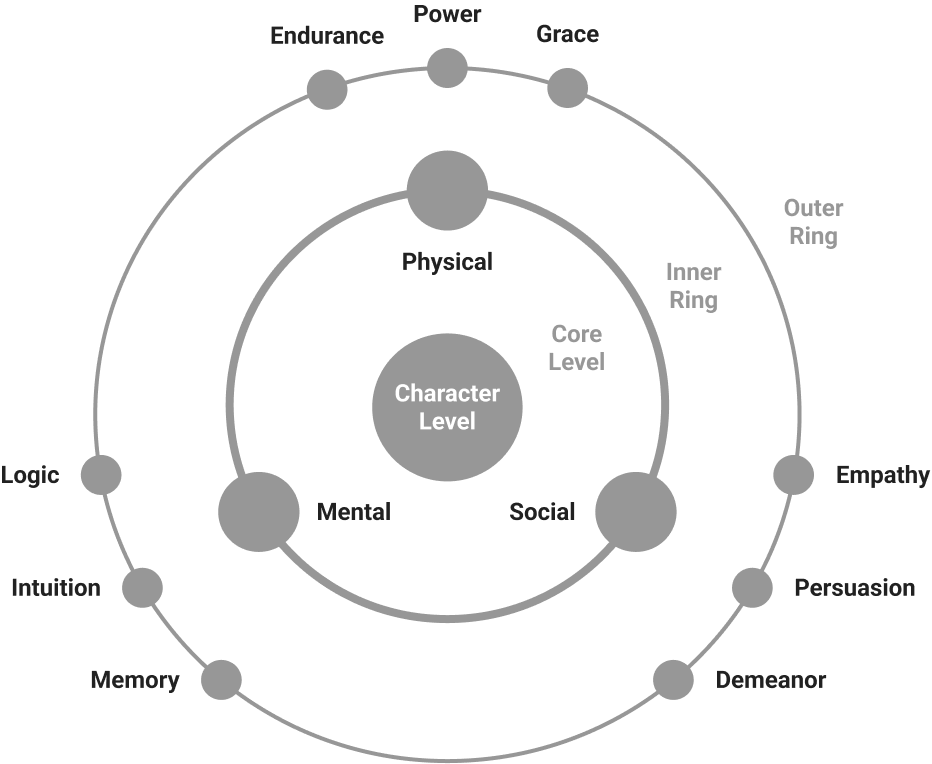
A character's stats are intended to be a representation of that character's physical, mental, and spiritual limitations. Stats are used to track a character's growth or to show a character's level of capability. There are two kinds of stats a character invests in, and they are directly linked. A character's Inner Ring stats determine baseline statistics like Hit Points, Vibe Points, or Savvy Points. A character's Outer Ring stats determine Skill Checks and access to feats. A character's Species will govern a character's Level 0 stats and will contain maximum values a character's stats cannot exceed.
- When your character gains a level you get a point to spend in any Inner Ring stat.
- Adding a point to an Inner Ring stat gives you 3 to spend in the Outer Ring of that category.
- The maximum that can be spent on any Inner or Outer Ring stat is 20.
- Traits, Equipment, or other effects can cause these stat totals to rise above 20.
- Hit Points & other resource mechanics are dependent on scores from the Inner Ring.
- Skill Check bonuses and access to certain feats are dependent on scores from the Outer Ring.
- Each point put into a stat is tracked in the dot bar; both of these visualizations are meant to be illustrative of a character's stats at a glance. Neither is strictly required, as the stats they describe can be more compactly described in other ways.
- An ogre can be all physicality but may only be smart enough to use a club.
- A soldier needs to be smart enough to know how to load a musket and graceful enough to aim it.
- A spy may be incredibly persuasive and have the Demeanor to fit in anywhere but probably needs Memory to remember what he sees.
Example stats
- Some Species will have lowered maximums; the below example is a human and cannot exceed 15 in any Inner or Outer Ring stat due to the Unexceptional Trait in the Species section of its Background.
- The below character started with 1 in each stat due to the human Generalist Trait in the Species section of its Background.
- Humans are intended to be the average baseline in this system.
- This example character has 9 points spent in Physical so 27 to spend in the Outer Ring stats.
- This character has spent only 2 points in Social and 1 in Mental, so its access to Traits that go beyond simple feats of brute strength will be very limited.
- Each point gives a Trait that is Universal (circle/odd number) or based on the character's Background (square/even number).
- Universal Traits are available to any character, Background feats have requirements based on Species, Origin, or Profession.
- This character has oriented their stats to be a strong, but brainless and crude character with a lot of Power and Endurance. Maybe they swing a Great Club (Endurance 4) (Power 8) like a barbarian or have a set of Plate Armor (Endurance 8) (Power 4).
- This character lacks the Grace or Intuition to be able to use a Fencing Sword (8 Grace) (4 Intuition) with any effectiveness, even if they got their hands on one.
- They're definitely not becoming a Master Pilot (Memory 5) (Intuition 10) (Grace 5) (any Pilot skill) anytime soon.
Physical
Social
Mental
Stat Types
Physical
Endurance
Endurance represents the body's ability to resist and persist. A high Endurance means a character is hardy and resilient to the elements, attacks, and deprivation. Such a character can go longer without eating, march for longer without tiring, and ward off diseases or poisons more easily. A durable character isn't inherently strong, but they are consistent.
Power
Power represents the body's ability to generate force, be it lifting heavy objects or jumping high distances. A high Power means a character can lift more, push harder, run faster. Such a character has an easier time climbing, has a higher jump distance, and swings harder with an axe. A powerful character isn't inherently resilient, but they can perform impressive feats for short periods of time.
Grace
Grace represents the body's ability to act with accuracy and control. A high Grace means a character can throw accurately, dance gracefully, and perform dexterous and delicate actions. A graceful character isn't inherently fast or powerful, but every action they take is made more effective by their agility and efficiency of movement.
Social
Empathy
Empathy represents the character's ability to interpret others, be it understanding their emotional state, picking up on subtle tics and cues in their body language, or quickly interpreting orders. A high Empathy means the character can read others like a book, understand their thoughts and desires, and quickly ascertain if someone is acting suspicious. An empathetic character can't inherently convince others to see their point of view, but they can quickly understand what makes someone tick.
Persuasion
Persuasion represents the character's ability to convince others, be it through a well-structured argument, persuasive rhetoric, or simple force of personality. A high Persuasion means the character can get the better of negotiations, convince others of a lie, or command loyalty in their troops. Persuasion doesn't make someone likable or respected, but they can get their way despite that.
Demeanor
Demeanor represents the character's control of their own vibe, be it acting cool under fire, the ability to command a room, or the ability to fade into a crowd. A high Demeanor means that a character can seem trustworthy at a glance, can look poised for the camera, and can command loyalty from their troops. A high Demeanor doesn't mean a character inherently understands or can control others, but looking the part and not cracking under pressure can go a long way.
Mental
Logic
Logic represents the character's ability to work through problems in a systematic and rational manner, be it solving a complex math equation, understanding what a few footprints and broken branches mean, or counting their bullets in a firefight. A high Logic means a character can think abstractly and systematically to figure out complex problems or during difficult situations.
Intuition
Intuition represents the character's ability to read a situation without all the facts. A high Intuition means a character can make the leaps in logic needed to get through a challenge quickly and naturally, be it estimating how long the rations will last, reading their opponent's movements for a perfect parry, or figuring out the missing ingredient in a potion. A high Intuition doesn't mean a character knows or understands the situation, but it can give them an edge regardless.
Memory
Memory represents the character's ability to store and recall information. A high Memory will allow a character to remember an obscure fact they learned in school, recall a suspicious face that walked by them at lunch, or recite a prayer without error. Memory doesn't help someone put together the facts in their head but is the starting point for many mental tasks.
Stat-Based Resources
Health and Hit Points (HP)
Hit Points (abbreviated as HP) are used to calculate the amount of physical harm a character or object can receive. Hit points are intended as an abstract measurement of the hardiness, size, and capacity to absorb punishment that an object or character possesses. Lost HP do not directly correspond to specific forms of damage but are instead intended as an at-a-glance measure of the health of a character or object.
HP's are calculated with a starting basis of 10 + each point a character possesses in a Physical Outer Ring stat. A max-level Human who has spent every level increasing their Physical stats will have 55 HP before Equipment or Traits are accounted for. HP's are lost as a character is harmed and regained slowly over time or quickly through the use of equipment, abilities, or RP occurrences. Unless hit points have been lost, a character always defaults to possessing their maximum number of HP.
As HP's are lost a character or object will gain or lose Temporary Condition Traits such as Injured or Incapacitated. The HP-related traits are listed following this section. Several of these traits have no inherent effect but interact with other game systems. Additionally, a character may gain Temporary Condition Traits that describe specific injuries they've incurred, but these are not directly tied to the character's hit point total, though Condition Traits such as Severe Bleeding may result in a character continuing to lose HP at a steady rate until their injury is treated. Typically such conditions are conveyed through RP reasons or through Effects or Abilities attached to the thing that harmed them.
At their most resilient, a maxed-out human character can sustain roughly 5 times the damage of a starting character before being incapacitated. While that may sound like a lot, it's actually rather low. Comparative systems like D&D sit at around a 30x multiplier. This system, however, does not have the same levels of exponentially increasing numeric values as more combat-oriented systems and contains numerous ways to increase HP outside of simple leveling.
- Healthy - Conveyed - Condition
Temporary (A character or object gains this trait while they are at their maximum HP total)
This Trait has no effect on its own. - Injured - Conveyed - Condition
Temporary (A character gains this trait while they are below their maximum HP total)
This Trait has no effect on its own. - Severely Injured - Conveyed - Condition
Temporary (A character gains this trait while they are below half their maximum HP total)
This Trait has no effect on its own. - Incapacitated - Conveyed - Condition
Temporary (A character gains this trait while they are at less than a quarter of their HP total)
This character has been incapacitated by their injuries and can no longer perform voluntary actions or perceive the world around them. - Dead - Conveyed - Condition
Temporary (A character gains this trait if they are at 0 or less HP)
This character is dead and cannot perform voluntary actions.
This character cannot be healed by any means unless otherwise stated. - Damaged - Conveyed - Condition
Temporary (An object gains this trait if it is below its maximum HP total)
This Trait has no effect on its own. - Destroyed - Conveyed - Condition
Temporary (An object gains this trait if it is at 0 or less HP)
This object has been destroyed and no longer functions in any intended capacity.
This object cannot be repaired by any means unless otherwise stated.
Vibe Points (VP)
VP are a spendable resource that can be used to improve a character's skill checks in socially oriented RP scenarios or can be spent on abilities that incur a VP cost. A character has a maximum number of VP's equal to the total number of their Social Inner Ring stat. Certain Traits and equipment can increase the number or recovery rate of Vibe Points. VP's are regained slowly, over time, and are an important resource to store up and manage when delicate negotiations are expected or when a character really needs to intimidate a guard or get them to look another way.
VP's can be spent on:
- Rerolling a single die in a socially related skill check (such as to try again when lying to a guard about your motives)
- Asking the GM to improve the results of a socially related skill check (such as improving the result of a negotiation over the price of a new car).
- Using an Ability with a listed VP cost such as using the Forgettable Face Trait to make a passerby forget your character's face once per point spent.
Savvy Points (SP)
SP are a spendable resource that can be used to boost a character's skill checks in mentally oriented RP scenarios or to gain access to intuitions or abilities such as those granted by feats or background checks. SP are regained slowly, over time, and are an important resource to store up and manage when being tossed into new situations or when a character is outside of their depth. A character has a maximum number of SP's equal to the total number of their Mental Inner Ring stat. Certain Traits and equipment can increase the recovery rate of SP's. SP's can be spent on:
- Rerolling a single die in a mentally related skill check (such as to try again when attempting to decipher or remember an obscure piece of history)
- Requesting competence or advantage depending on which is applicable to the situation at hand (indicating that the character is using their intuition or savvy to navigate their way through a situation they may not be experienced with)
- Using an Ability with a listed SP cost such as using the Born Navigator Trait to automatically succeed in discerning a ship's direction when all that's available is the wind and waves to judge by.
Explaining Traits
Traits
Traits, alongside a character’s Stats and Equipment, are the defining characteristics that make a character who and what they are. The Trait system is flexible and functions as a catchall category of things a character knows, things a character can do, things a character belongs to, and relationships the character may have with others. Traits are named and self-contained characteristics categorized by what the Trait is and how it interacts with characters and the game’s systems. A Trait will typically either be part of a structured category that defines how the Trait is used, or it will contain a description that describes how the Trait manifests itself.
Traits are almost always additive, conveying some additional capability or capacity that a character has, though a rare few can convey negative attributes or restrictions. Trait effects are wide-ranging, from bonuses to certain skill checks to combat buffs to new abilities. They can describe a character's relationships to a society, such as memberships in exclusive organizations or even a wanted status for a criminal on the run. Traits can be temporary conditions, such as describing the ramifications of a character's broken leg. Because Traits are so varied, they will typically be organized on a character’s sheet by their theme or by how they are used.
Characters start with a series of Traits based on their background packages. A character’s Species, Origin, Profession, and Past all grant a starting package of Traits that will help to inform who and what a character is. From there a character gains additional feats through accruing experience and leveling up or through in-game circumstances.
There are three primary ways permanent Traits are gained:
- They are granted by a background package when the character is created.
- They are granted automatically every time a character levels up.
- They are gained through in-game actions or occurrences.
Temporary Traits can be granted through equipment or can be based on temporary circumstances, such as an injury sustained or short-term fame gained from a notorious act. Temporary Traits should have the time or circumstance of their ending in their description.
- Traits are self-contained pieces of information assigned to a character or object with specific requirements and effects.
- Traits will typically list their name, category, type, and effect in a single place of reference. Traits can be listed by their name on character sheets and in descriptions, with the Trait's effects referenced only when needed.
- Universal Traits or background Traits are given at every level, alternating between Universal (odd-numbered levels) or background (even-numbered levels).
- If, when a character levels, they do not wish to gain a new Trait they can "bank" that Trait, until an in-game RP circumstance presents them with the opportunity to gain a Trait that they want. This is a good way for a player to gain Conveyed Traits without it feeling forced.
- Backgrounds can give additional Traits, and typically provide several when adopted that provide a baseline of Traits that inform a character's background and circumstances.
- Traits can have an Outer Ring skill level requirement.
- Traits can be gained outside of leveling and can be lost.
- Traits can be temporary.
- Traits always have a category, like Knowledge or Condition, that determines how the Trait is used in the game.
- Traits can have a type like (Supernatural), (Injury), or (Cybernetic). These will typically be used in concert with in-game effects that target specific types of Traits, such as a doctor healing Injury Traits. These types have no effect on their own.
- Traits that would require training can only be gained if the character has received training relevant to that Trait or has been performing a related action for long enough. This is at the GM's discretion.
- Some Traits will require a character to already possess a prerequisite Trait in order to be gained (Such as a Pilot Trait being a prerequisite for the Expert Pilot Trait).
- Some Traits have specific, listed, role-playing requirements.
- Unless it is a Ranked Trait, a Trait's effect does not stack. Multiple instances of the same Trait will only have the effect of a single instance of that Trait.
Trait Ranks
Some Traits, such as all Knowledges, can be Ranked up. These are different from Traits with successive requirements, such as Marksman being a requisite for Master Marksman. Ranked Traits do not change when Ranked Up, but provide a multiple to their bonuses equal to their rank level. As an example, Pilot: Small Boat (3) has been ranked up 3 times and provides a Roll Modifier to a piloting skill check of +30, representing the Trait's bonus of 10 multiplied by the three times it has been ranked up.
A Trait can only be Ranked up beyond Rank (1) if the character has each required Stat for that Trait greater than or equal to 3 times the new Rank level. As an example, a character wishing to Rank Pilot: Small Boat to Rank 3 would need Grace and Memory stats of at least 9.
Universal and Background Traits
When a character is selecting Traits while leveling up they will pick either Universal or Background Traits depending on their level. Unless a Trait is specified as Background, then it is assumed to be Universal. Background Traits are typically skills, areas of knowledge, or abilities that are related to a character’s Past or identity. A character selects Background Traits from a list generated by their background package. Some Background Traits will have RP requirements; these will be listed in that Trait's requirements. As an example, a human can't just grow longer teeth, but an aged Orc's fangs can continue to grow as their power or prestige advances, conferring social benefits to them. This would be represented by the Longfanged Trait, and in its description it will describe bonuses to social situations between Orcs.
Many Traits in the list generated by a character's background package are Universal Traits that are thematically related to that background package. These give a character an opportunity to take or advance these Traits rapidly, especially if they are Ranked Traits. A character with a Profession of pilot will be able to take or Rank up pilot-related Traits at double the speed of a character that does not have those Traits in their background list.
Starter-only Traits
These are background Traits that can only be taken during character creation, representing some unique skill, nest egg, or heirloom the character possesses that they gained at some point during their lives. Many starter Traits will have specific requirements, such as the Pirate Scion Profession being required for the Starter Trait Inherited ship.
Conveyed Traits
These are Traits that cannot be taken when a character levels up unless the GM allows it. These will often represent tangible improvements to a character that would be difficult to justify without a relevant roleplaying rationale. As an example, the Eagle Eye Trait implies a tangible and significant improvement to a character's long-distance vision. This could come about as a result of mystical training, mutation, a latent ability of a Species or Origin, or some other rationale. Conveyed Traits will often not have a minimum stat requirement.
Trait Categories
Because Traits can take so many different forms, they are subdivided into seven categories. The categories listed below represent the fundamental basic categories of a Trait. A Trait's category determines how it interacts with characters and the game's systems.
Knowledges
Knowledges are Traits that are gained exclusively either by in-game RP effort or are conferred by background packages. Multiple backgrounds can confer the same knowledge Trait, but unless otherwise specified, this does not increase the knowledge's rank. Knowledge can be learned multiple times, but each rank increase involves a commensurate level of increased time, difficulty, or financial investment. Knowledges and additional knowledge ranks can also be conferred by items, magic, or cybernetics or can be gained temporarily via research, but there are limitations to how these forms of knowledge can be utilized.
When creating a new character, a player can choose to use universal or background traits that they would gain due to their level to gain knowledge Traits instead. This is to represent additional areas of knowledge the character would have accrued up to that point in their lives but that may not be specifically written out in the character's background packages (such as the character getting a bachelor's in history, allowing them to gain History (2) as a starting character from the Terran Demarchy). It is up to the GM to decide how high a knowledge rank can be gained in this way.
Outside of character creation, knowledge can only be gained via in-game RP occurrences, such as a character spending a semester learning fencing or a character having the layout of a forest magically conveyed to them. It is at the GM's discretion to determine how easy or difficult knowledges are to attain and where their limitations are.
Languages
Languages confer the ability for the learner to speak or read/write in that language. Language traits represent a character's ability to communicate using that language. Most languages will be granted by a character's background package, but languages can also be temporarily granted by ex machina devices like universal translators or magic amulets. Languages can also be learned in the same fashion as knowledge Traits. Languages function as both knowledge and an ability in that they describe a character's ability to understand and use a language. A language Trait will typically describe how the character can use that language, such as English (Spoken).
Skills
Skill traits represent a character's ability to perform a specific task or engage in a specific activity without fumbling or failing to even understand the basics. A skill is like knowledge in that it is a learned Trait, but unlike knowledge, skill Traits can be gained over time through training and effort, even without outside aid. Many skills are ranked Traits and represent the additive bonuses conveyed through practice and mastery in a given task. Other skill Traits represent additional improvements or aspects of mastery that go beyond a simple bonus to a die roll during a skill check. Mastery skill Traits will typically list prerequisite traits that a character must already possess before they can take the more advanced Trait. Skill Traits can be selected when a character is choosing level-up skills, but it is recommended that the GM only allow them to select skill Traits they had been learning or utilizing.
Abilities
Abilities are Traits that confer some sort of ability to a character. This can come in a wide variety of forms, from a character's ability to fly being granted by Natural Flight to a character's ability to Hide in Plain Sight conferring their ability to sneak and go undetected even while being observed. Abilities are the most common kind of trait to be conferred by items or equipment, as they represent some sort of specific physical or mental feat that a character can perform. Not all abilities are physical, but most manifest as something other than modifying a skill check. Often abilities are Innate to a Species or culture and will be automatically conferred to them by their Species or Origin packages. An ability Trait will always describe what it does and when it can be used, though it will be at the GM's discretion to determine the boundaries of when an ability can be applicable to a situation.
Circumstance
Circumstance Traits describe a character's relationship with the world around them and will typically list noteworthy or exceptional characteristics. While virtually any description of a character's place in society could be listed as a Trait, this should be reserved for important or unique aspects of a character. As an example, membership in a thieves guild would be listed as a Circumstance Trait, but membership at Costco would not.
Conditions
Condition Traits are Traits that represent some sort of ongoing status. These will typically describe some sort of ongoing effect a character is experiencing, whether physical or mental. Condition Traits can vary widely in what they represent and will almost always have their effects described in the Trait. These can range from a character having cybernetic arms, granting them significantly improved Power stats, to a character being a conduit for the spirits and thus able to see ghosts. Injuries will often be represented as temporary Condition Traits and will describe some sort of negative attribute or incapacity forced onto the character.
Other
Other is a catchall category and represents special Traits that go beyond the norm. Most Other Traits are, in reality, multiple Traits listed at the same time for the sake of convenience. As an example, a character being possessed by a daemon may have that possession listed as an Other Trait, and that Trait's description may describe significant alterations to how that character would otherwise function.
Example Traits
Knowledges
Languages
Skills
Abilities
Circumstances
Conditions
Other
Background-Only
Skill Checks
What is a Skill Check?
Skill checks are a process by which an action a character undertakes or a situation they are presented with requires measuring the character's attributes or abilities in some way. Skill checks take a variety of forms, from measuring a character's raw strength or mental fortitude to testing a character's ability to ride a horse or solve a complex equation. Skill checks, as a game mechanic, are expressed through a die roll on a d20, and the result of that roll is compared against a target value. Meeting or exceeding the required value is a success; falling below is a failure. The die roll will typically be modified by a character's stat values, equipment they may be utilizing, or any number of other factors.
Skill checks will typically have one or more associated Outer Ring stat values. Add the associated stat total to the roll for the check. Some effects will require established stats outlined by the rules associated with whatever is requiring the check, but in most situations the GM will determine what stats are being measured. When a skill check asks for an Inner Ring stat, the character can decide which of the Outer Ring stats in that category they wish to use.
Skill checks are a way for a Game Master (GM) to measure a character against some form of adversity or to grade their performance. A skill check may have a target value that is known to the player or one that is known only to the GM. Some skill checks may not have a target value at all and are instead looking to see how "good" the roll is and rationalizing how that character's effort meets their need (such as establishing the quality of a character's work of art). How skills are truly utilized is typically a style of GMing more than a hard and fast set of rules.
Ex. A character may have to take a lifting (Power) skill check in order to lift a very heavy object.
Ex. A character may have to take a fear (Demeanor) skill check to avoid cowering at the sight of a dragon.
- Skill check results are rolled on a d20. The result of this roll is then modified by all roll modifiers and compared against a target value. If the skill check meets or exceeds the value, it "succeeds." If the roll falls below the value, it "fails."
- Most skill checks will reference an Outer Ring stat. When a skill check references a stat, you add the character's stat value to the total.
- If a skill check references an Inner Ring stat, the character can choose one relevant Outer Ring stat to add to the die roll.
- Some complex skill checks will reference more than one Outer Ring stat. For these checks the player needs to roll for each stat separately. The result is a combination of those successes and failures, and that result is up to the GM. Ex. A spy driving a car in a foreign land could have a skill check against both their Grace and Memory. The first for the act of driving itself, the second to demonstrate that they remember the road laws of the country they are infiltrating.
- Skill success is a gradient; succeeding by a small amount may technically succeed but may incur some unforeseen event. Meanwhile, failing or succeeding hugely may result in significant benefits or consequences. The extent to which a character succeeds or fails is up to the GM.
- Ex. You were not detected while sneaking but stepped on a twig. The guards are now more alert.
- Ex. You failed the jump but can still catch the ledge with your arms to avoid falling down the pit.
- Ex. You brewed a potion perfectly, slightly amplifying its abilities.
- Ex. You fumbled the lock and broke the mechanism; you can't try again.
- Some skill checks can be repeatedly attempted until the character succeeds or stops trying. It is up to the GM to decide what checks can be repeated and how long they take.
- If a character's modifiers to the roll would mean that roll automatically meets or exceeds the check's target value, the player can forgo rolling at all if they wish, though the GM may still ask for them to roll in order to know how far they exceed the requirement.
Requesting Advantage
- A character can request advantage in a situation where they believe they are uniquely advantaged in the effort of performing some sort of task or skill or in a role-playing scenario.
- Some feats will specify a situation where a character can request advantage that is tied to a specific skill set or physical attribute
- Requesting advantage is an expression of both the stats written on a character sheet and the character's backstory and role-playing attributes.
- Some races, backgrounds, or professions will infer the right to request advantage in a broad set of circumstances, such as a character with a small stature being able to request advantage when hiding or a professional soldier's ability to request advantage when learning to wield a new weapon.
- The GM can allow or deny requested advantage and will determine the appropriate expression of the advantage.
- Ex. A character with a background as a fisherman may be able to request advantage in a situation where they need to maintain balance while the airship they are on is suffering severe turbulence due to the character's past with the rocky seas. The GM could choose to give them a +5 to their Grace roll to stay standing.
- Ex. A character is a pilot and is piloting the ship they built by hand and know by heart. The GM could choose to give them a bonus to a skill check or even waive the need for the skill check if the act could be considered routine.
Requesting Competence
- A character can request competence in any situation where they believe other related factors give them enough of a baseline level of capability that they shouldn't be penalized as harshly or at all for lacking a specific skill.
- A character with expertise in wielding a sword can request competence when wielding a dagger, even if they don't have a feat giving them that skill.
- Requested competence can result in a wide range of results, from the user being wholly proficient in the task at hand to even being granted a relevant feat that gives them that skill permanently.
- A bard skilled with a guitar and a bass can likely request competence with a lute, but the GM may consider the violin to be a step too far.
- Many feats that grant expertise in a skill also grant inferred competence in related skills.
Skill Check Difficulty Ranges
Skill check requirements range from -10 to 80, with an explanation of what those values represent below. Higher checks require higher relevant rolls and modifiers to succeed. A check that notes a stat can have that stat added to its total. A Complex check that notes multiple stats must roll separately for each stat. In general, as actions grow more complex or multi-staged, the relevant skill checks will require more stats to be rolled against at once.
Checks at 0 or below are automatically accomplishable even with no skill and often even with difficulty modifiers to the check. These would only be checked if there was a realistic chance of failure.
Checks between 1 and 20 are accomplishable by any character as long as there are no difficulty modifiers. There is a 20x gap between a check of a 1 and 20 though, and while having relevant stats, equipment, or feats may make these checks easy or even automatic, a character not fit for the task may find them almost impossible.
The difference between a requirement of 20 and 40 is often the difference between requiring novice or expert training, or requiring simple or advanced equipment. Accomplishable by characters with high stats, relevant feats, or equipment. Many professions have their day-to-day actions in this range. Skill checks in this range are often still heavily impacted by raw stat values.
The difference between a requirement of 40 and 60 is often the difference between the daily acts of a master in a profession and something that requires days or weeks of prep time, perfectly attuned equipment, and external forces acting to make the check succeed. Accomplishable by characters with advanced feats and high-end equipment. Often both. While stats may have an impact on the roll, skill checks at this level rely more on training and preparation than on talent. Most extreme skills are in this range.
Checks between 61 and 80 are absurdly difficult or are considered impossible by normal means. If a complex task looks like it's in this range, it may be better to break it down into multiple smaller tasks.
Items, Armor, and Effects
Armor and Effects
Resisting Damage Types
Resistances are used to reduce incoming damage by a specified amount. Resistances begin at zero. Incoming damage will always have a type, and some forms of attacks will do multiple types of damage at once. A fiery explosion will do both blunt damage through the explosion itself, as well as heat damage through the heat of the fireball. Resistances are predominantly conveyed through equipment, but some Traits may provide additional resistances. A character's resistances are cumulative; if a character has both leather armor and scaly skin, their resistance to slashing will be higher than if they had either alone.
Some resistances will have coverage areas specified, such as a helmet providing significant protection, but only on the head. How and where a character is hit is covered in the section on combat. Resistances can, in rare cases, be a negative value. In these cases they add to the damage inflicted a value equal to that negative number.
Damage Types
Physical
Blunt
Blunt attacks are those that impact evenly across a wide area, such as a strike from a club or the wide blast front of an explosion. Any sudden change in pressure, such as being thrown out an airlock, would also be tracked as blunt damage. Blunt attacks can often cause the Concussed Temporary Condition Trait.
Slashing
Slashing attacks are those that cut across a wide area, such as a swing from a sword or a slash from animal claws. Slashing attacks can often cause the Bleeding Temporary Condition Trait.
Piercing
Piercing attacks are those that impact sharply in a small area and pierce deep, such as a thrust from a spear or the impact of a bullet. Piercing attacks can often cause the Bleeding Temporary Condition Trait.
Elemental
Heat
Heat represents the damage caused by very high thermal energy/temps being applied to an area, be it from fire, a laser, or any other source. Fire is a common form of elemental damage that can be encountered easily both in and out of combat. Heat damage can often cause the Burning Temporary Condition Trait.
Cold
Cold represents the damage caused by thermal energy being removed from an object or character, be it from contact with ice, exposure to the elements, or any other source. Cold damage will most commonly be a result of exposure to extremely cold climates, and the ways this damage manifests itself will often be outside of combat. Cold damage can sometimes cause the Frozen Temporary Condition Trait.
Electrical
Electrical represents the application of electricity to a system that isn't built to handle it, be it from lightning, a downed power line, or an electric eel. The threat of electric shock is far more common in a modern electrically powered society, but it's a classic element of magic. Electrical attacks can often cause the Concussed Temporary Condition Trait.
EMP
EMP or Electromagnetic Pulse is a catchall term for electromagnetic damage that is specifically harmful to machines or computer systems that rely on electricity or magnetic attributes to function. EMP damage's most common interaction will be to disable or destroy mechanical or electronic systems, either intentionally or accidentally. EMPs can be caused by natural or manmade phenomena, from solar flares to nuclear explosions. EMP damage can only harm characters or objects with the Mechanical Trait.
Supernatural
Metaphysical
Metaphysical damage represents the damage inflicted by any higher plane source and does not interact with normal matter in a scientifically understood manner. Metaphysical attacks or effects will contain a description for if and when they do extra damage or possess other effects. Metaphysical effects will often be associated with other traits or keywords that further define their interactions in the game.
Ex. A paladin's sword that bypasses the armor of the Demonic or an enchantment that only harms the Undead.
Death
Death damage represents a loss of vitality or the sudden rotting of flesh that would be otherwise considered scientifically impossible. Attacks or effects with the death attribute will often describe debilitating secondary effects they inflict beyond the HP damage they cause; successful (Physical) checks can often resist these effects. Death damage or attacks cannot typically harm those with the Mechanical Trait.
Psychic
Psychic damage represents harm inflicted directly upon one's brain, ego, consciousness, or other mental capacity. Psychic attacks or damage will typically bypass all defenses and will inflict various Condition Traits, with Concussed being the most common. Successful (Mental) or (Social) checks can often resist the effects of Psychic attacks/damage.
Other Common Elemental Effects
Radiation
Radiation is an element in nature that can cause the Irradiated(1) Condition Trait. Levels of radiation exposure can cause different and increasingly severe effects, and certain effects or resistances in the game will make a user resistant or immune to radiation. Much like in real life, radiation can spread, and a character or object with a high level of the Irradiated trait can, in turn, inflict that trait on others.
Acidic/Corrosive
Acidic or Corrosive effects will often cause damage to items or equipment in addition to any character wielding them. This will most commonly be represented by the Corroded(1) ranked trait to be inflicted on an object that has been affected.
Items
What is an Item?
An item can be any physical object that a character can be in possession of. This can range from weapons to armor to currency to pets. Some items have considerable complexities of their own, such as a ship or a warhorse. Other items are as simple as a gold coin. All fall under the category of "items." Within the category of "items," there are several subcategories explained below. Items possess their own descriptions, functions, weight, and size and may confer abilities or be used by a character in a unique way. Items will typically be described somewhere external to a character's character sheet, but in cases where the item is truly unique (such as a fancy rock the character found), then the GM can describe the physical characteristics of the item in question. Items are recorded in the "items" section of the character sheet. There is no limit to the number of items a character can possess, though there are reasonable limits on what they can carry. A character may possess a house on their character sheet, but they aren't taking it around with them.
Exclusivity
Some items have exclusive functionalities that cannot be duplicated, whether because you can’t easily wear two pairs of shoes, only have one set of eyes to be cyberized, or a magic amulet gets… jealous. These items will typically label themselves as exclusive and will list one or more items or categories of item. If a character has an item equipped, it cannot then have another equipped that shares a type with the listed exclusion. It is at the GM's discretion whether or not an item is exclusive with another, and exceptions can sometimes occur.
Ex. (exclusive: Footwear)
Uses
Many items have a limited number of uses before becoming defunct or literally ceasing to exist. If an item has a limited number of uses, the number and nature of that limitation will be in its description.
Ex. (candy bar: uses 1: when consumed)
Damage, Condition, and Destruction
Most items can be damaged or destroyed. When an item has various stages of degradation that can occur, it may be in its description, though often it will be at the GM's discretion, and additional descriptions may be added to an item relating to its condition. Larger or more complex and important items may have their own hit points or armor values. If no such values are present, then the GM can assign such values, or an item can simply be assumed to either be pristine or broken with no in-between. A destroyed item does not vanish except when circumstances say otherwise. A destroyed glass could still exist as glass shards waiting to be stepped on. The tracking or importance of a destroyed item is up to the player or GM.
Most items should not have their condition tracked unless it is important or relevant to the game (ex. A shield needn’t have its hit points tracked unless another character is explicitly trying to chip or destroy it with a weapon capable of doing so).
The various types of equipment and unique attributes (if any) are described below.
It should be noted that while these categories are used in-game to sort and describe items, these categories are not absolute and many items will have uses or effects that could place them into multiple categories.
Wearables
This category comprises any passively worn object or garment that is used without intention or effort. Hats, rings, and chainmail would fall under this category, as would more complex items like powered armor or even a magical force field. What separates wearables from equipment is that wearables are passive; they convey their benefits or effects without the character having to take action.
Mundane or generic wearable items like everyday clothing do not necessarily need to be recorded on a character sheet and can be assumed to be possessed unless otherwise stated.
Equipment
This catchall category comprises a wide variety of concepts. But the unifying feature is that equipment is useful and will typically have some sort of effect or feature in its description, often granting some sort of ability or benefit to a character when utilized. Watches, grappling hooks, jet packs, cell phones, or magic wands could all be considered equipment. Vehicles, weapons, wearables, and other categories of item could be considered equipment, and when they have equipment-like functionalities or natures, they will often be listed as equipment in addition to their other categories.
Weapons
Weapons are a special form of equipment meant to cause damage or harm. Not every item capable of doing damage is a weapon, but most weapons exist specifically for that purpose. Weapons will convey abilities related to their use but often have a related trait or skill requirement to be used effectively. Anyone can pull a trigger, but hitting a target is a different matter. Weapons are often relatively complex forms of equipment and will need care, maintenance, or correct setup to be used correctly. Sometimes a weapon will need to be paired with another form of equipment, such as a bow requiring an arrow, but just as often they will not. Most weapons will be considered exclusive, though traits or GM discretion may allow for multiple weapons to be used simultaneously.
Structures
"Structures" is a catchall term for any item that exists, is unmoving, and can be occupied. Structures will typically be large and solid constructs built to be occupied or to accomplish some sort of task, but just like buildings in real life, they can have innumerable forms and purposes. Structures are not equipped; instead, characters will occupy a structure. The maximum total occupancy of a structure will always be defined in its description and will often feature not just total characters but other values such as the weight or size of what it can accommodate. In situations where these numbers are unset or so large that tracking them isn’t useful, a “-” will be listed, and these values are at the GM's discretion.
Structures are large and complex items and will often have hit points, armor values, and levels of destruction. When a character is occupying a structure, they are typically considered to be inside of and protected by it (presuming the threat isn’t inside the structure with them or they aren’t exposed in some other way).
Vehicles
Vehicles are a special form of item that is used to move or protect characters. Like weapons, vehicles will often have a related skill requirement for their use. Unlike weapons, vehicles are not equipped; rather, characters (or other things) will occupy a vehicle like they do structures. Vehicles will always list a maximum number or nature of occupants (though in some instances that value will be listed as a “-”, similar to structures). In these instances the maximum occupancy is at the GM's discretion.
A vehicle is typically ridden/piloted/driven by one or more characters, though sometimes the vehicles will either control themselves or be at the mercy of other forces (ex. A boat adrift in the tide or a runaway train). Vehicles are a relatively wide category of item that can encompass animals or structures and will typically have a list of their properties in their description.
Vehicles often require routine maintenance and upkeep, though if that is important or tracked within a game is at the GM's discretion. Similarly, vehicles will often have hit points or conditions listed, though it is at the GM's discretion if they want to add additional complexities to the maintenance or handling of a vehicle. (Ex.: It is at the GM's discretion if a car's gas tank explodes or if the players had to fill that gas tank or even pay attention to the concept of fuel.)
Animals robots & animal-like NPCs
Animals are, in many ways, like characters. They can typically move, have hit points and defensive values, can equip and use items, and often can think and act independently. The most important distinction between an animal and a character is that the animal doesn’t warrant the creation of a character sheet and will typically have its traits listed in a compressed fashion. An animal will usually have its characteristics be derived from a baseline template that is then modified via traits.
Animals and animal-like NPCs have behaviors and will take actions on their own, though they are typically animalistic or robotic in nature. A trained animal or well-programmed robot will have a trait conveying that they can be interacted with and given commands. Often only specific listed characters will be able to command an animal or robot, though it is at the GM's discretion when and why this can occur.
Animals and animal-like NPCs can equip and use items, though the items they can use will typically be listed or at the GM's discretion.
- Animals and animal-like NPCs will always have hit points and armor values.
- Animals and animal-like NPCs will have their characteristics defined by a template and are then modified via traits.
Misc
Misc. items are items that do not neatly fall into another category or which are unimportant or generic objects that could have a multitude of uses. A brick would be a misc item; it could be thrown as a weapon or used to build a structure, but by itself it's just a… brick. Most items in an environment can be considered miscellaneous.
Sample Character Sheet
Musings on the process for creating a character
- Character Level is tracked separately from Outer Ring stats.
- Inner Ring stats are listed as a single number docked to their Outer Ring lines.
- The Outer Ring lines start unfilled, and are filled in as the player adds points to them, looking at the circle or squares to know what kind of feat they gain.
- Characters select a race, origin, profession, and past.
- The character's race determines their starting stats, max stats, grants any unique ability the race may possess, and grants access to various feat categories.
- The character's origin grants access to a starting set of origin feats, typically a mix of regular and knowledge feats. It also grants access to selectable feats related to the origin as well as other RP specific things (wealth, identification, etc).
- The character's profession grants access to a starting set of profession feats, typically a mix of regular and knowledge feats. It also grants access to selectable feats related to the profession as well as other RP specific things (equipment, licenses, etc).
- Since characters start with Outer Ring stats related to their race they will typically start with a set of player-selectable feats. A human starts with 1 point in each Outer Ring stat, so they start with 9 universal feats in addition to the feats automatically granted to them by their race, origin, profession, and past. Since they also only have a single point in each stat (plus three points for level 1) their selection will be relatively limited to less powerful and more common feats.
- It may be preferable to start a campaign with characters at level 2 or 3, so that they can pick out the low level but still specialized feats their character would possess and to help them differentiate from each other.
- This character has selected to use two of its universal feats gained at level 1 to increase its knowledge in contraband and security; it can do this due to being a freshly created character. Future stat gains cannot be used to gain knowledge feats, though this is at the GM's discretion.
Backgrounds being used in the sample character sheet
Species: Human
Generalists
Humans start with 1 point in every Outer Ring stat.
Unexceptional
Humans cannot exceed 15 in any Outer Ring stat unless otherwise modified.
Versatile
Humans can take cybernetics feats.
Biological
Humans can take genetic engineering feats.
Origin: Terran Demarchy
Public Education
Terrans start with the following knowledge feats
Homeworld Interlag (language)
Terran History (1)
Terran Geography (1)
Terran Law (1)
Profession: Smuggler
Skill Feats
Smooth Talker
Concealment
1 additional Contact
Knowledge Feats
Contraband
Security
1 additional Language
Past: Raised By The Streets
Skill Feats
Schemer
Sleight of Hand
1 additional contact
Knowledge Feats
Streetwise
Criminal Activity
1 additional Language
Edwin Humble
10 HP
|2 VP
|1 SP
1 Blunt
|0 Piercing
|1 Slashing
|0 Energy
Description & Backstory
- Race
- Human
- Origin
- Terran Demarchy
- Profession
- Smuggler
- Past
- Raised By The Streets
- Cash
- 2,000
- Wealth
- 15,000
- Languages
- Terran Standard, Spanish, Orcoid
Edwin Humble is a Void-Truck driver and part-time smuggler in the orbit of the Terran Demarchy’s capital of Earth. Raised rough at a young age, Edwin was cared for by his mother in the teeming streets of Chicago before stowing away on his father's cargo shuttle during one of the man's rare visits. The boy quickly learned the trade of private cargo running, both the legal and less-than-legal sides of it. After a delivery went south and his father was killed, Edwin took over the ‘family business’ and runs a small-time cargo transportation operation out of his own name, though his real income comes from what’s stored in the secret compartment at the back of the shuttle. Edwin's two goals in life are to get rich and to find out who was responsible for his father's murder.

Physical
Social
Mental
- Knowledge: Terran History (1)
- Knowledge: Terran Geography (1)
- Knowledge: Terran Law (1)
- Knowledge: Contraband (2)
- Knowledge: Security (2)
- Knowledge: Streetwise (1)
- Knowledge: Criminality (1)
- Knowledge: Terran Standard
- Knowledge: Spanish
- Knowledge: Orcoid
Knowledges
- Smooth Talker (1)
- Concealment (1)
- Schemer
- Sleight of Hand (1)
- Act Natural (2)
- Wheelman (1)
- Pilot (basic automotive) (1)
- Pilot (basic voidcraft) (1)
- Backroads Traveler
- Rapid Appraisal
- Scrounger (1)
Skills
- Inheritance (Rickety Cargo Shuttle)
- More Lucky Than Good
- Forgettable Face
- Contacts (1)
Other Feats and Abilities
Items and Equipment
- Sturdy Leather Jacket (1 blunt, 1 slashing, torso)
